Welcome to the dedicated website for my book – Answers in the Dark: Grief, Sleep and How Dreams Can Help You Heal. Available to order through your buying options below.
The 4am Mystery: that’s an actual thing by the way. Even before a global health crisis took the shape of COVID-19, people around the world were finding themselves sleep deprived, awake in the middle of the night.
You might be someone who says, no matter what you do, you just can’t sleep. Sometimes you know why: your thoughts are racing, or a nightmare has startled you into consciousness. Other nights you might toss and turn and, just as you finally doze off, the alarm blares.
This book was written for you.
It explores why you’re awake, how you can manage your mind at night, and what might help if it’s your dream content wreaking havoc.
Drawing on nearly two decades of therapeutic work, research, and an ancient wisdom proven to helpfully manage the mind, Delphi connects the dots between sleep, dreams and our mental health. She particularly highlights the impact of grief and loss on our well-being, which can ultimately affect the quality of our night-time rest – even if no one has died. Her book guides the reader on a journey to make friends with night-time, learning what the dark might have to offer, to achieve a calmer, healthier, happier life.
Answers in the Dark aims to offer food for thought and start a conversation about the topics featured. Check out your buying options at the top of this page.
This topic features in Answers In The Dark : Grief, Sleep and How Dreams Can Help You Heal (intention setting, p.198) and I’ve offered additional context of this below. Please note this article is not intended to be prescriptive. Please read these policies for terms and conditions.
We’ve been exploring the importance of dreams for centuries. But can we really receive wisdom while we sleep?
The short answer is yes! Dreams can offer insights that may provide food for thought on our current challenges, reflect on past events and may even predict the future.
We also know that some people become lucid in their dreams, which means they are aware of the fact they’re dreaming in the dream. They are then able to use and adapt the content in ways that work for them, like preparing for an important meeting or presentation the next day. (Some people even become lucid during flying dreams!)
There have also been famous people throughout history who reportedly used their dreams as a way to solve problems while they slept. Albert Einstein was said to have dreamt his theory of relativity and Elias Howe apparently invented the key component of the sewing machine on the back of a dream he had.
So what might help?
Can we really receive wisdom while we sleep?
Dream Questioning
One way to seek wisdom from our dreams (which can also help us remember them) is to try asking a question before bed and see if the wisdom you need reaches you while you sleep. This is sometimes known as Dream Incubation.
Here’s some tips:
1. Be clear about the question you want answering before you go to sleep, that ideally could offer up a yes/no (or a relatively straightforward) answer. It could be something like: “Should I look for a new job?” or “Is it time to move house?”
2. You could then write the question in your dream diary before you go to sleep. I explain in Answers In The Darkthat keeping a dream diary is a great way of spotting patterns in your dreaming (see also video below), but you can also use it to set the intention to both remember your dreams and potentially incubate a dream this way.
Some people then place the piece of paper or dream diary under their pillow to show they mean business, but it’s up to you.
3. You might then decide to meditate on the question before you go to sleep. If nothing else this could also help you relax.
You might find, when you wake up in the morning, a dream provides some insight into the problem you’re facing. It could take a few nights for the intention to sink in, so you could try playing around with the question if what the dream is offering isn’t clear straight away.
Keep in mind that dreams are inherently cryptic and so how you interpret their meaning is ultimately up to you. If you’re asking a question about a potential date, for example, make sure that your dreams aren’t reflecting your fears and keep an open mind about the answers they provide.
Dream Incubation is thought to be an ancient practice and in some traditions, people may have used ingredients like valerian to increase their chances of achieving it; however, this is an extremely potent plant, and should be used with caution. Your dreams can be useful without trying to force their content.
Over time, your dreams may well provide the answers you’ve been looking for. Only do this practice if it feels right for you.
Delphi is a qualified counsellor, educator and author of the #1 best seller, Answers In The Dark: Grief, Sleep and How Dreams Can Help You Heal, available to purchase from Amazon, Hive and all good bookstores. (#1 Best Seller on Amazon for its category.) For more services to help you find your mojo and get your sparkle back, visit HelpingYouSparkle.com.Content on this website may appear elsewhere to promote Answers In The Dark.
Buy Now
The 4 am Mystery: That’s an actual thing by the way. Even before a global health crisis, people found themselves awake in the middle of the night. Answers In The Dark aims to join the dots between sleep, dreams and our mental health, specifically how grief shows up, even if no one has died.
It explores some of the Big Myths of sleep, offers a Sleep Cycle Repair Kit and tips on how to decode your own dreams.
Available to purchase Amazon, Hive and all good bookstores.
Please note this article is not intended to be prescriptive. Please read these policies for terms and conditions.
This topic features in Answers In The Dark: Grief, Sleep and How Dreams Can Help You Heal and I’ve offered additional context of this below. Please note this article is not intended to be prescriptive. Please read these policies for terms and conditions.
According to various commentaries, including from the World Health Organisation, insomnia is a global problem*. Many people have trouble falling asleep or staying asleep, and when they do wake up, feel like they’ve not slept at all.
We know the pace of life affects our quality of sleep. Technology makes us easily interruptible at all hours of the day, and the never ending news cycle can leave us feeling edgy as we try to go to sleep. It’s no wonder if we’re waking up tired.
But these aren’t the only things that keep us up at night.
When I was writingAnswers In The Dark: Grief, Sleep and How Dreams Can Help You Heal, I realised how many of us have bought in to several big myths. One of them shows up in most internet searches or popular magazines that contain a ‘Sleep Special’; they will often suggest that we all need eight hours sleep every night. But this might be one reason we’re not always getting a good night’s rest; when we find ourselves awake in the middle of the night we worry we’re not going to get our eight hours.
We’ve bought in to this myth so much that we largely plan our day around it. If you have to be up at 6am, you might work back eight hours and tell yourself you have to be in bed by 10pm the night before. But what if you’re not sleepy then? (The video below briefly explains the feeling of sleepiness).
Believing we have to be in bed by the time we say so, can cause us to feel stressed if we don’t then instantly drop off. We think we ‘should‘ be asleep, and become agitated when we’re not. And there’s no way the brain will authorise sleep when we’re stressed.
And here’s another thing.
We know that we sleep in cycles (Answers In The Dark contains a section called The Sleep Cycle Repair Kit), and these cycles follow a particular route (it’s why I describe sleep as like a bus, discussed in the video above).
We ideally go to bed when we’re sleepy, complete a number of cycles and wake up naturally each day. The problem is, if you set your alarm for 6am (working forward eight hours from 10pm), it might actually be set to go off right slap-bang in the middle of deep sleep.
This also happens when we take an afternoon nap and set our alarm for an hour, instead of a short amount like 20 minutes, or the full length of a sleep cycle (about 90-120 minutes). You wrench yourself out of sleep, trying to continue with your day, only now you’re experiencing what’s sometimes known as the Hangover Effect: you’ve got a headache, your mouth is dry and you don’t know what year it is.
So one reason we might be feeling so tired is we’ve hauled ourselves out of deep sleep when we need to wake up more naturally.
So here’s the tip: Ditch the myth and focus on quality not quantity.
Some people will need six hours at night, others might need 10. Teenagers need more sleep, just as you probably do when you’re poorly, and when you’re older you might find you need less.
If you have to get up at 7am, but know you’re naturally awake by 6 o’clock, don’t trick yourself in to thinking you’ll just get another cheeky hour in. If you allow yourself to doze back off, you might find you then wake up feeling groggier than before.
Of course there are other things that can cause us to feel tired, including fatigue from a range of illnesses which is why a trip to the doctor is best if it’s really becoming a problem. If you work shifts, this can also be more challenging as can circumstances – like bereavement – that are affecting your sleep in the first place (the video below might help). There is a benefit in taking power naps when you can (I talk more about that in the book too). But where possible try to work out when you’re naturally wakeful and set your alarm for then, rather than wrenching you out of deep sleep.
Measure your sleep quality by how refreshed you feel when you wake up, and where possible try to go to bed when you’re sleepy and wake up naturally, as close to when you need to get up. You can also try some mindfulness activities (there’s a range of these in Answers In the Dark), as well as talk to someone during the day, about what might be keeping you up at night.
Delphi is a qualified counsellor, educator and author of the #1 best seller, Answers In The Dark: Grief, Sleep and How Dreams Can Help You Heal, available to purchase from Amazon, Hive and all good bookstores. (#1 Best Seller on Amazon for its category.) For more services to help you find your mojo and get your sparkle back, visit HelpingYouSparkle.com.Content on this website may appear elsewhere to promote Answers In The Dark.
Buy Now
The 4 am Mystery: That’s an actual thing by the way. Even before a global health crisis, people found themselves awake in the middle of the night. Answers In The Dark aims to join the dots between sleep, dreams and our mental health, specifically how grief shows up, even if no one has died.
It explores some of the Big Myths of sleep, offers a Sleep Cycle Repair Kit and tips on how to decode your own dreams.
Available to purchase Amazon, Hive and all good bookstores.
Please note this article is not intended to be prescriptive. Please read these policies for terms and conditions.
This topic features briefly on p.188 of Answers In The Dark: Grief, Sleep and How Dreams Can Help You Heal and I’ve offered an extended view of this type of dream below. Please note this article is not intended to be prescriptive and as the dreamer, you are the best person to decide what your dream means. Please read these policies for terms and conditions.
School and, for some, college or university, can be part of our formative years. It’s here we may form (lifelong) friendships and begin to shape our outlook on life. What happens during these years can have an impact, whether pleasant or unpleasant, and therefore show up in our dreams, even in later years.
Dreaming of being back at school can be a metaphor that reflects we may be navigating a period of learning. Perhaps something is happening in life right now that could be described as a “learning curve”; you may have learned something about yourself, someone else or life itself.
We sometimes use language like “life lesson” – (not that we needed to be “taught” something or punished, just that’s how we phrase or emphasise the impact it’s had), which could also explain this type of dream.
Or you may be thinking about going back to school, starting a new qualification or a change of career, which requires a new period of learning in your life.
How you experienced school will also influence how you interpret this dream.
If school was a happy time, you might find the dream is taking you back to good times, and the feeling of being carefree again.
If school was difficult, ask yourself why you might be having this dream again now. What’s happened that would remind you subconsciously of the time you were at school. Perhaps you’re feeling the same pressure now, as you did back then.
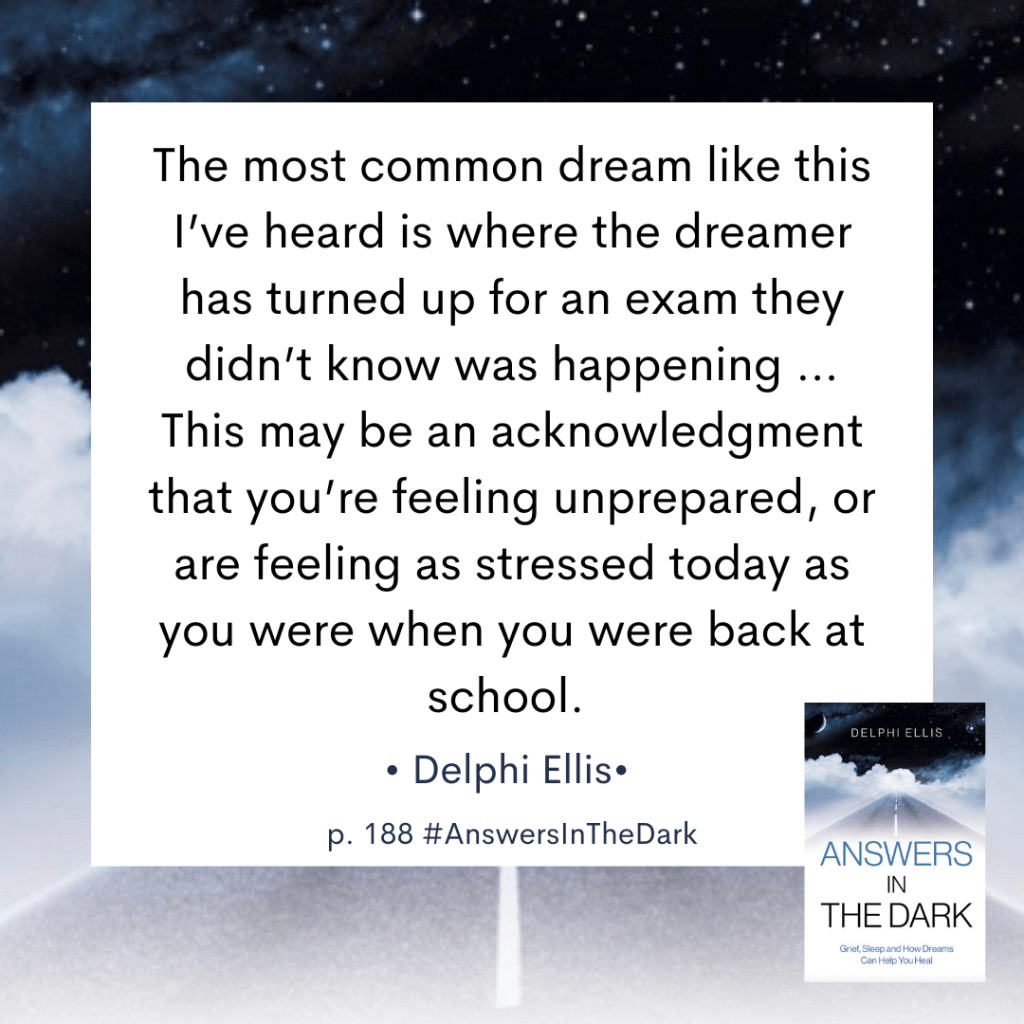
Taking exams in dreams often presents itself the way described above – not knowing about it and not feeling ready. This can mirror how life can be – something happens we’re not ready for and not prepared for how we might cope with it, or what the outcome or results might be.
Dreams like this can symbolise the stress experienced when back at school, especially around exam time. The dream can serve to remind us that we’re getting stressed again maybe as we did back then, and so it’s time to start managing the load.
It can also be a common dream if working to tight deadlines, or where time is a pressure. It can symbolise trying to keep on top of everything, and then something comes out of the blue which adds to what you’re already doing. And of course if you’re a teacher, it could reflect your waking life too.
Sometimes it might represent feeling as if being tested by life. If lots has happened, and you’re being pushed emotionally to the limits, talking it through with someone can be helpful.
You may also find keeping a dream diary useful (I offer a template in my bookAnswers In The Dark), as you may start to notice patterns and see clues as to why you have this dream when you do. See more on this below.
Top tips for School and Exam Dreams
Have a think about how stressed you are and what positive changes you can make to help you relax. Having a good bedtime routine, like winding down before sleep, can also be useful (there is a Sleep Cycle Repair kit in Answers In The Dark).
Consider whether you’ve been going through a period of learning. What, if anything, are you feeling tested by? These can provide insights as to the meaning of your dream.
Try keeping a dream diary. You might find you have this dream because of something that’s regularly happening in your life at the time.
Always do what’s right for you.
Delphi is a qualified counsellor, educator and author of the #1 best seller, Answers In The Dark: Grief, Sleep and How Dreams Can Help You Heal, available to purchase from Amazon, Hive and all good bookstores. (#1 Best Seller on Amazon for its category.) For more services to help you find your mojo and get your sparkle back, visit HelpingYouSparkle.com. Content on this website may appear elsewhere to promote Answers In The Dark.
Buy Now
The 4 am Mystery: That’s an actual thing by the way. Even before a global health crisis, people found themselves awake in the middle of the night. Answers In The Dark aims to join the dots between sleep, dreams and our mental health, specifically how grief shows up, even if no one has died.
It explores some of the Big Myths of sleep, offers a Sleep Cycle Repair Kit and tips on how to decode your own dreams.
Available to purchase Amazon, Hive and all good bookstores.
Please note this article is not intended to be prescriptive and as the dreamer, you are the best person to decide what your dream means. Please read these policies for terms and conditions.
The 4am Mystery: that’s an actual thing by the way. Even before a global health crisis took the shape of COVID-19, people around the world were finding themselves sleep deprived, awake in the middle of the night.
You might be someone who says, no matter what you do, you just can’t sleep. Sometimes you know why: your thoughts are racing, or a nightmare has startled you into consciousness. Other nights you might toss and turn and, just as you finally doze off, the alarm blares.
This book was written for you.
It explores why you’re awake, how you can manage your mind at night, and what might help if it’s your dream content wreaking havoc.
Drawing on nearly two decades of therapeutic work, research, and an ancient wisdom proven to helpfully manage the mind, Delphi connects the dots between sleep, dreams and our mental health. She particularly highlights the impact of grief and loss on our well-being, which can ultimately affect the quality of our night-time rest – even if no one has died. Her book guides the reader on a journey to make friends with night-time, learning what the dark might have to offer, to achieve a calmer, healthier, happier life.
Answers in the Dark aims to offer food for thought and start a conversation about the topics covered. See your buying options at the top of this page.




 Answers in the Dark™ by Delphi Ellis